
How Dr. Vin AI car inspection works: upload used car listing photos, get instant AI damage detection with component grades for exterior, interior, tires, wheels, and glass. Each finding includes repair cost estimates and confidence scores. Pre-purchase vehicle inspection from photos without visiting a mechanic.
How Dr. Vin Works
You upload photos. Dr. Vin tells you what's actually wrong with the car and what it'll cost to fix. Here's what happens in between.
You bring the photos
Listing screenshots, your own shots, dealer photos. 3 to 30 images from any source. That's all Dr. Vin needs.
Each photo is indexed, resized for optimal model input, and stripped of EXIF metadata. If a license plate is visible, Dr. Vin reads it and looks up the vehicle's VIN through a licensed plate-lookup service, then decodes that VIN with NHTSA's public vehicle database to confirm year, make, model, and trim. Detected plates are redacted from the stored photos, and the vehicle identity is locked in before analysis starts.
Dr. Vin looks at everything
Every photo is analyzed for scratches, dents, paint issues, tire wear, interior damage, and signs of prior accidents. Each finding gets a confidence score and a typical shop est. to fix range.
Dr. Vin analyzes each photo individually with a vision model, scoring it against a detailed per-component rubric spanning hundreds of individual condition variables. Findings are cross-referenced across all of your photos so a single bad angle doesn't skew the result, and each finding carries its own confidence score.
Repair costs come from a proprietary cost matrix calibrated from published industry repair-cost data: CCC and Mitchell labor rates, Manheim and NAAA auction-condition standards, KBB repair guides, PDR pricing, and wholesale reconditioning data. Those costs are then adjusted for regional labor rates across seven U.S. zones. Dr. Vin weights each finding by its confidence, modeled as a Bernoulli probability, inside a Monte Carlo simulation, so the condition-impact ranges reflect real uncertainty rather than point estimates or guesses. Value-impact multipliers translate raw repair cost into what the damage means for the car's worth, and private-party discount factors account for the gap between dealer and private-sale pricing.
None of this would be possible without Phototology's Aletheia Engine, turning photos worth a thousand words into a thousand words.
You get a report, not a data dump
Overall condition grade. Component scores. Every finding with photos, locations, and what it costs. Dr. Vin's Verdict on whether the listing earns your Saturday. Negotiation leverage. All of it organized so it actually makes sense.
The report is structured, not generated. Findings are grouped by severity and component, color-coded by condition zone, and presented as a narrative that tells the story of the car's condition. The goal is not to impress you with data. It's to make the next conversation with the seller a short one.
What Dr. Vin actually sees
Real photos. Real findings. Drag the slider to see what Dr. Vin found on this 2004 Lexus LS 430.
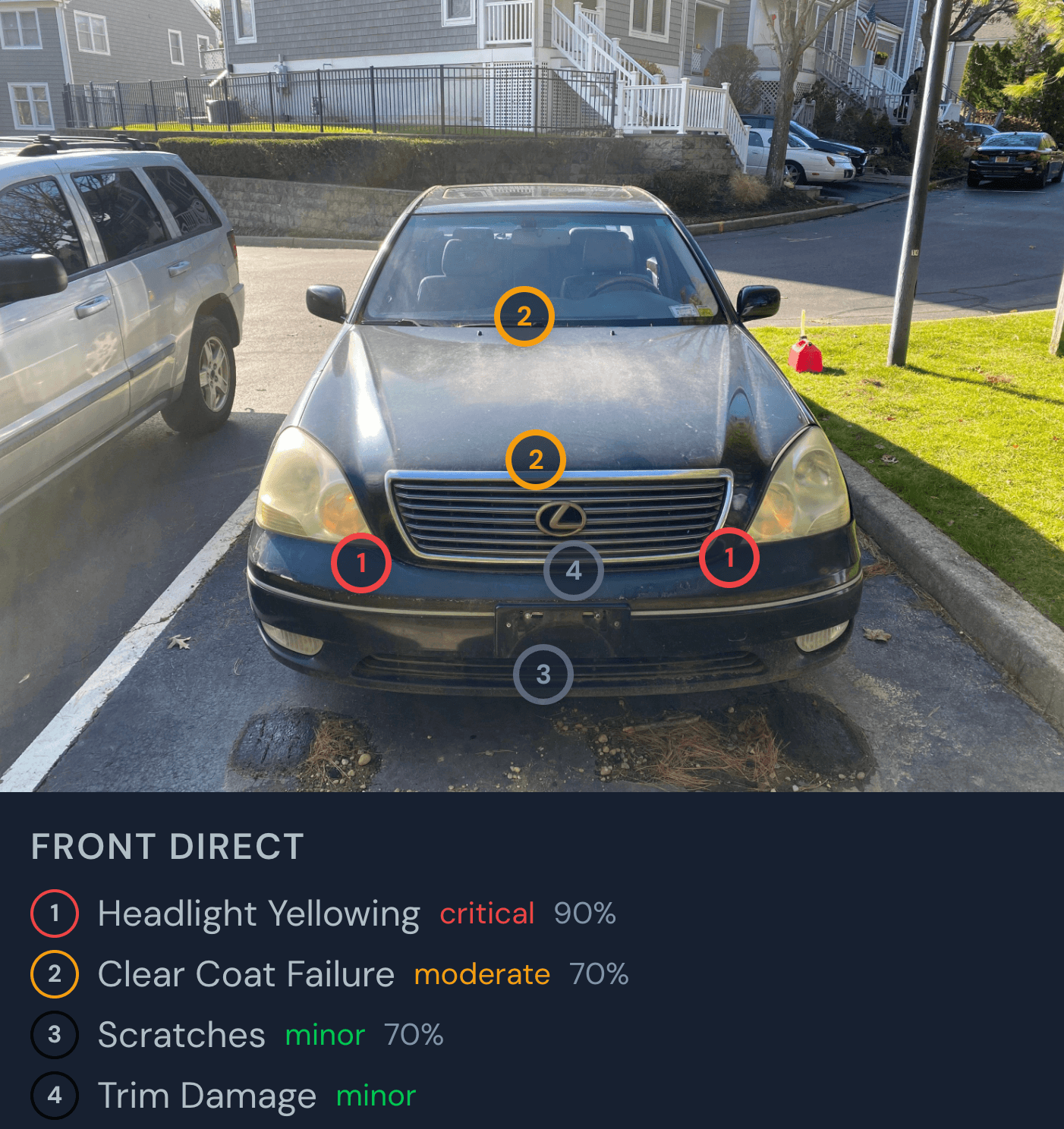
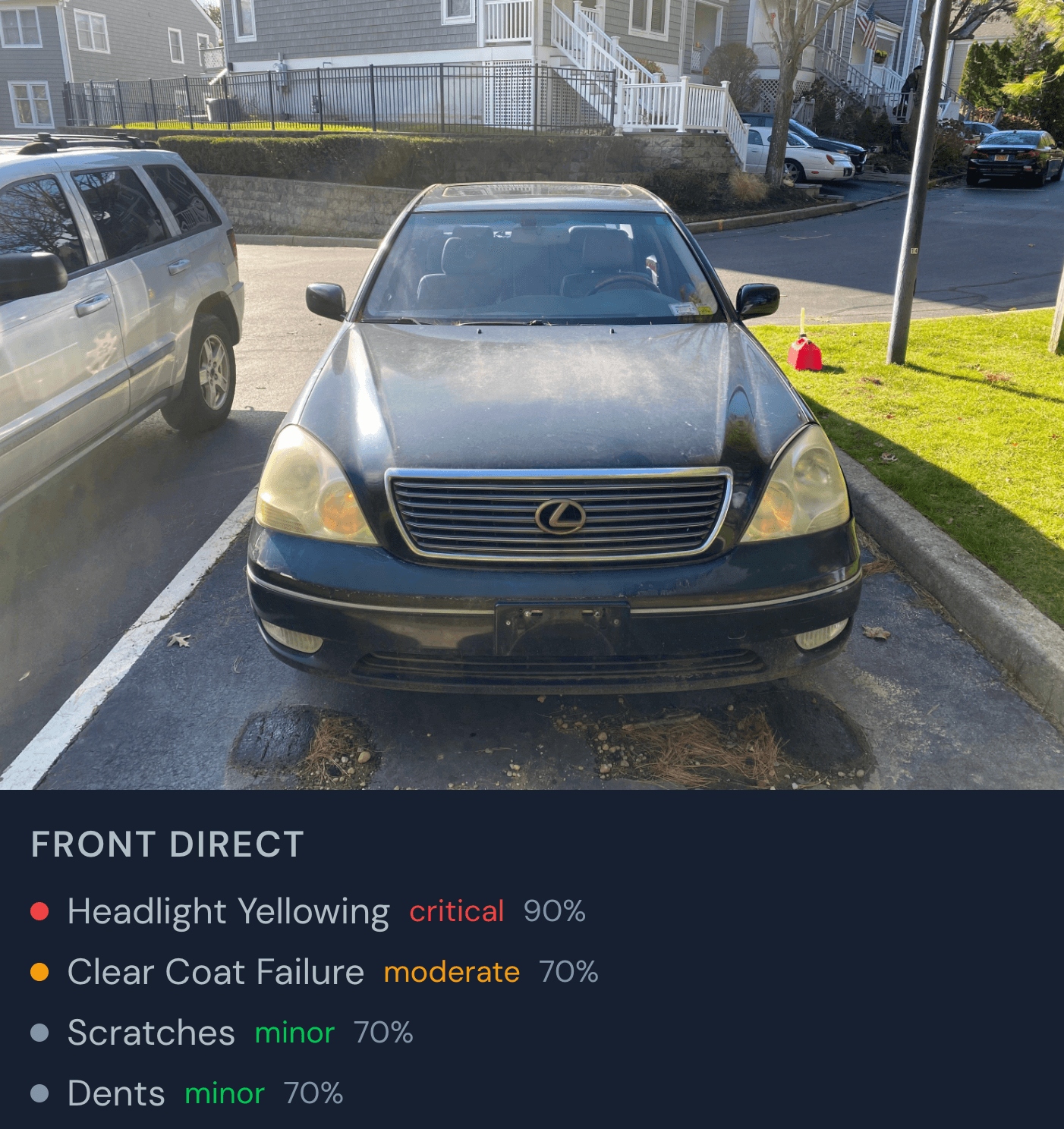
front bumper · driver side fender
hood-to-fender
driver door · rear quarter panel
passenger side · rear bumper · trunk lid
both headlights
Every finding is spatially located on the original photo using bounding box coordinates, and each carries its own confidence score from the vision model. Findings are cross-referenced across all of your photos, so a single bad angle doesn't skew the result.
Honest about what we are
Dr. Vin is a photo-based screening tool. He's really good at what he does. He doesn't pretend to do what he can't.
What AI sees
- Paint defects and color mismatch
- Body damage, dents, and panel gaps
- Tire condition and tread wear
- Interior wear and damage
- Glass and light damage
- Accident and flood indicators
What requires hands-on
- Engine and transmission
- Brake system
- Hidden frame damage
- Electrical and HVAC
- Suspension and drivetrain
- Odometer verification
That's why we built the 60-point inspection checklist for everything you need to check in person.
How we estimate value and score Listing Clarity
Dr. Vin gives you an estimate, not an appraisal. It is an AI-generated visual pre-screen from your photos, not a mechanic's inspection or a VIN history report. Like any estimate it carries a margin of error, and it is meant to sharpen your questions, not to replace a hands-on inspection or a test drive.
How we estimate value
When we can find them, value estimates blend grounded comparable listings for the same year, make, model, and trim with standard depreciation. When we cannot resolve enough comparable listings, we say so and show no number, rather than guess. We never present a generic placeholder figure as if it were a real valuation.
How Listing Clarity is calculated
Listing Clarity is a 0 to 100 measure of how clearly the photos present the car. It is a weighted blend of three published sub-scores:
- Coverage, about 53% of the score: how many of the standard angles the photos actually show.
- Photo Quality, about 33%: sharpness, exposure, and framing of the photos.
- Findings Transparency, about 13%: how completely the visible findings are shown across the photos.
Whether the photos look original and unedited is tracked separately, as its own provenance indicator, and is not folded into the Clarity score, so a limited authenticity read can never drag Clarity down on its own.
Listing Clarity measures the listing's photos, not the car's condition. A well-photographed car with real problems can score high, and a sound car with thin photos can score low. The two are kept separate on purpose.
Known limitation
Clarity rewards complete, original-looking photos, but a clean photo reused from another listing or a stock image may not always be caught. Read a high Clarity score as a sign the listing is easy to assess, not as a guarantee that every photo is of this exact car.
That's it. Photos in, answers out.
60 seconds from upload to report.
Run ReportVisual Diagnostic free · The Prescription is $15